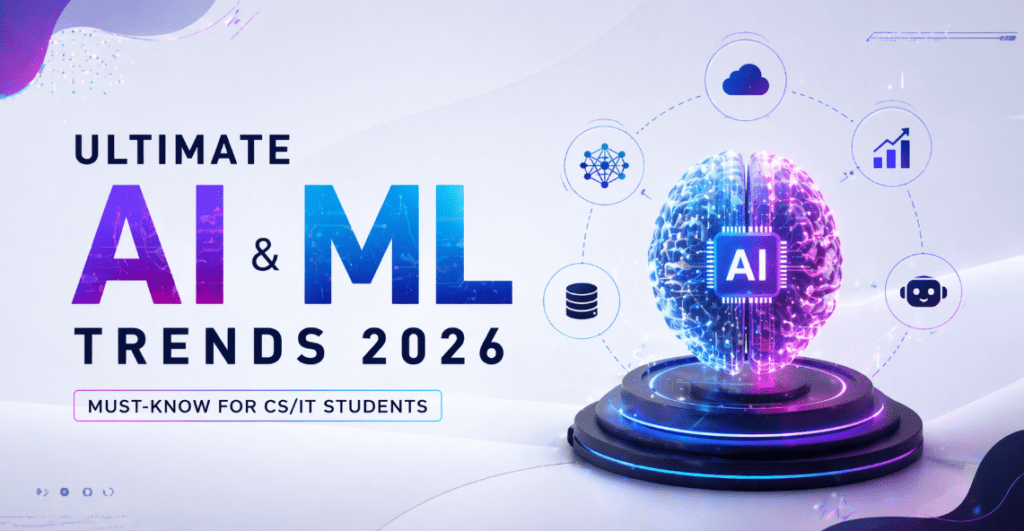

If you’re a CS or IT student right now, you’re probably hearing the words “AI” and “Machine Learning” more than anything else. And honestly, it’s not hype anymore. It’s real, it’s everywhere, and it’s moving so fast that sometimes it feels like you blink for a week and suddenly something new is trending.
But here’s the thing:
You don’t need to follow every single update. You just need to understand what’s actually shaping the future — the things that will matter when you sit in an interview, build your portfolio, or plan your career.
So instead of giving you textbook definitions, let’s talk like normal people and go through the AI & ML trends for 2026 and the upcoming years that are genuinely worth your time.

1. AI Agents Aren’t Just Bots Anymore — They’re “Mini Employees”
Remember when chatbots were only good for answering simple FAQs? Those days are gone.
2026 is the year of AI agents — basically AI systems that don’t just respond to you but can-do things for you:
- Book appointments
- Clean up your code
- Run small automations
- Search the web
- Summarize files
- Take actions inside apps
It almost feels like having a junior intern inside your laptop.
Why students should care:
Companies love people who can build workflows using AI agents because it saves time and money. If you know tools like LangChain, CrewAI, or OpenAI Assistants, you’ll instantly stand out.
Companies love those people who can build workflows using different AI agents as it saves a lot of time and money. If you happen to know tools like LangChain, CrewAI, or OpenAI Assistants, you will instantly stand out from the rest.
2. Generative AI Is Expanding Far Beyond Text & Images
We all have seen ChatGPT write essays, help to prepare for MCQ exams or generate artsy images. Good, but 2026 is bigger.
Now AI is stepping into:
- 3D generation
- Full video creation
- Voice cloning
- Digital humans
- Virtual rooms
- Game design assets
The line between “designer” and “techie” is getting thinner. Even game developers are using AI to generate character animations and landscapes that used to take weeks to create.
If you’re even slightly into design, gaming, media, or AR/VR — this is your zone.

3. AI + Cybersecurity = The Job Combo No One Should Ignore

Cyber attacks have become smarter. Hackers are already using AI to write malware, create fake voices, generate phishing emails, and find vulnerabilities.
Because of that, companies are using AI for defense:
- Anomaly detection
- Fraud spotting
- Real-time attack alerts
- Predictive security models
It’s like a cat-and-mouse game, but both sides have AI now.
If you’re into cybersecurity, this is the perfect time to mix ML with security. It’s one of the most stable and high-paying tech fields already.
4. Multi-Modal AI Models: One Model, Many Superpowers

Earlier, an AI model could either read text or see images or listen to audio. But the latest models can do everything at once.
They can:
- Read your PDFs
- Look at your screenshots
- Analyze code
- Generate charts
- Understand videos
- Listen to audio
This is a massive shift.
It means, the future apps which are being developed won’t be merely “chatbots”. They will be assistants who can understand whatever you provide them with.
5. AI Tools Are Becoming Every Developer’s Sidekick
Let’s be honest: nobody writes code from scratch anymore, and it’s not cheating.
Developers use:
- Cursor IDE
- GitHub Copilot
- ChatGPT
- Codeium
These tools don’t replace developers; they reduce the boring part of the job.
In interviews, companies won’t ask, “Do you use AI tools?”
They’ll ask, “How efficiently can you work with AI tools?”
So if you’re studying programming, learn how to use AI to debug faster, generate boilerplate code, and clean up your functions.
6. AI-Based Personalized Learning Will Replace Traditional Study Methods

One of the biggest silent revolutions is happening in education. Students now learn from AI-powered tutors that:
- Break down topics in simple language
- Generate practice questions
- Check your mistakes
- Adjust explanations to your style
Studying is becoming more customized, like having a private teacher 24/7. If you’re not using AI to study, you’re basically running a race with a self-imposed handicap.
Now a days, studying is becoming more customized like students can have a private teacher 24/7 in form of AI tools. If you are not using AI tools to study, you are basically on your personal try/catch block.
7. AI-Powered Automation in Every Industry

AI is now being used in places most people don’t notice:
- hospitals
- logistics
- agriculture
- hotels
- banks
- factories
Every industry has some form of ML running in the background — predicting, optimizing, or assisting.
What this means for students:
You don’t just study ML algorithms — you learn how they’re used in actual real-life problems.
8. Edge AI: Running AI Without the Internet

We are approaching a world where AI won’t be always restricted to live in cloud. It will run on:
- phones
- drones
- robots
- cameras
- IoT devices
This is called Edge AI. It is fast, private and it never relies on network speed. Skills like model compression, TinyML and embedded ML are becoming more important.
9. AI Ethics & Regulations Will Matter More Than Ever
AI is becoming powerful, and governments are stepping in. There are new rules around:
- privacy
- user consent
- deepfakes
- data usage
- transparency
As a future engineer, understanding these basics is crucial. You don’t need to become a lawyer, but you do need to know what’s allowed and what’s not.
Action Steps for AI ML Trends 2026 Students
AI and ML are no longer “future skills.” They’re “right now” skills. But you don’t need to panic or try learning everything in one go. Instead:
- If you’re a developer → learn AI tools + automation.
- If you’re into security → mix ML with cybersecurity.
- If you’re creative → get into GenAI for design.
- If you love hardware → explore Edge AI.
- If you enjoy data → multi-modal models are your playground.
The students who combine traditional skills with AI-driven tools will become the leaders in tech over the next decade.
References
- Industry Reports & Trend Forecasts
These organizations release annual AI trend reports trusted by researchers, companies, and universities:
- Stanford AI Index Report 2025–2026 – https://aiindex.stanford.edu
- McKinsey Global AI Report – https://www.mckinsey.com/mgi/overview
- Gartner Emerging Tech & AI Trends –https://www.gartner.com/en/research/trends
- MIT Technology Review — AI Section – https://www.technologyreview.com/ai
- IBM Global AI Adoption Index – https://www.ibm.com/watson/resources
- Learning AI & ML (Free Courses)
These are the most practical, beginner-friendly free courses:
- Google Machine Learning Crash Course
https://developers.google.com/machine-learning/crash-course
- Meta AI Learning Path (Free)
https://www.coursera.org/meta-ai
- DeepLearning.ai — Short AI Courses
https://www.deeplearning.ai/short-courses/
- Microsoft Learn – AI Essentials
https://learn.microsoft.com/en-us/training/browse/?products=azure-ai
- Kaggle Learn (Highly Recommended for Students)
https://www.kaggle.com/learn
- Stay Updated With AI News & Trends
- The Decoder (AI news) — https://the-decoder.com
- Hugging Face Daily Papers — https://huggingface.co/papers
- ArXiv Sanity Preserver (by Andrej Karpathy) — https://sanity-preserver.org
- AI Breakfast Newsletter — https://aidaily.co
- The Verge — AI Section — https://www.theverge.com/ai