
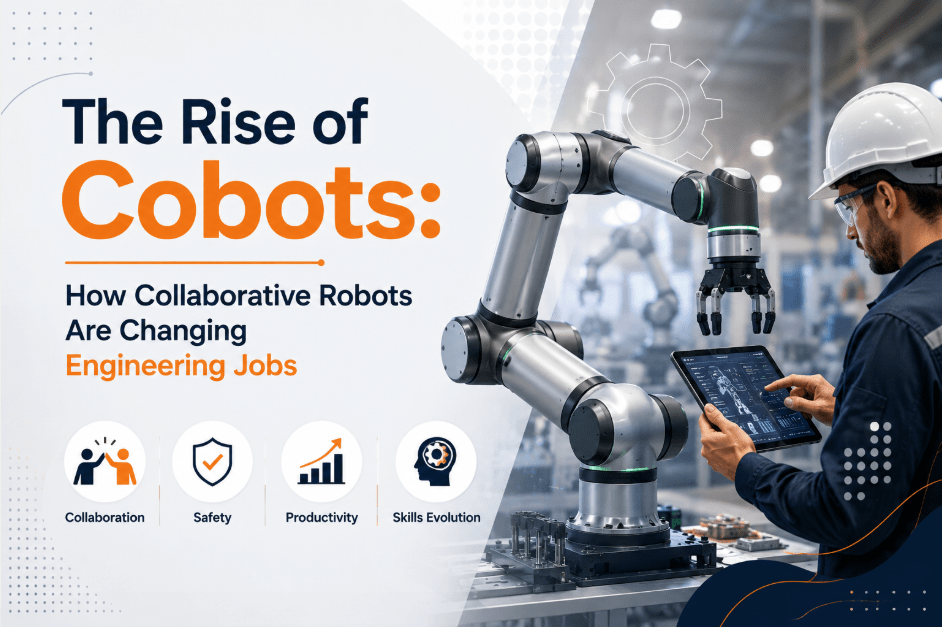

Factory floors are becoming friendlier. The giant, caged industrial robots of the past are being complemented, and in some cases replaced, by smaller, softer and more flexible machines designed to work alongside humans. These are collaborative robots, or cobots. Arms, mobile platforms, and mixed systems that don’t just automate tasks, they share them. Cobots will reshape where engineers work and how they do their jobs over the next decade, from the shopfloor to design rooms and supply chains, and they will change what it looks like to be an engineer.
What Is A Cobot?
A cobot is a robot designed to work safely alongside people. In contrast to traditional industrial robots, which are confined to enclosures and perform repetitive high-speed movements, cobots are typically lightweight, equipped with built-in force sensing, user-friendly teach interfaces, and safety features that enable them to decelerate or halt upon contact. They are often built for rapid redeployment: plug them into a new task and they will be up and running in hours or days, not weeks. “Many small and medium manufacturers are adopting them first because of that low barrier to automation, as well as flexible programming methods such as hand-guiding and tablet interfaces.”
Where Cobots Are Already Transforming engineering work
The following applications can be seen when it comes to cobots: assembly, machine tending, material handling, inspection of quality, and light welding and grinding. Cobots are being used in automotive and electronics factories for driving screws, placing small parts, handling materials into CNC machines, and examining printed circuit boards using cameras – applications that would previously either have been manually performed or performed with costly fixed automation equipment.
This is also why cobots are great in applications requiring small series or unique products, since in such cases re-tooling would not make sense financially. Practical uses of cobots range from assembling motorcycles to electronics factory cells, showing how they liberate humans from ergonomically unfavorable or repetitive jobs.
Cobot Market Growth (2025–2030)
And as costs decrease and capability increases, analysts predict dramatic growth in cobot markets over the next decade. Different market reports cite varying scales for the CAGR and totals, but they all trend in the same direction: swift growth as more industries embrace human-robot teams for flexible automation. The growth is driven by labour shortages in many areas, the need for quicker product changeovers, and the economic benefits of incremental automation (you don’t need to automate everything at once).

Safety Standards: ISO/TS 15066 Engineers Must Know
Cobots don’t take away safety responsibility – they shift it. Safety standards such as ISO/TS 15066 (a technical specification published in 2016) lay down requirements and guidance for collaborative robot operation, including risk assessment, permissible contact forces for different body areas, and measures for design and supervision. Engineers who integrate cobots must be aware of these standards, do risk assessments at the task level, and design fail-safes (speed limits, lightweight end-effectors, software interlocks) that fit the real human context. Compliance isn’t just about regulatory box-checking — it determines whether a cobot solution is deployable on a live, active production line.

Jobs: Displacement, Augmentation & New Roles
While it is easy to create a headline that suggests “no one wants robots to steal their job,” this statement has many shades of gray to it. In order for cobots to excel, they should handle the repetitive, physically dangerous or precise tasks, which allows people to perform the more valuable and creative aspects of their work.
The human experience is important. Significantly. New reports and studies show that working around lots of robots can ease physical strain but can also increase mental strain, like losing autonomy, doing repetitive monitoring tasks, or being under more surveillance. So engineers need to create systems that preserve meaningful work – for example by rotating human tasks, enabling skill growth and using cobots to augment not deskill operators. Firms that invest in reskilling programs and participatory design have higher productivity and worker satisfaction.
Skills Engineers Need in the Cobot Era
If you’re an engineer (or aspire to be one), the cobot era makes two things mandatory:
- Systems thinking: Cobots are not standalone devices, they are nodes in socio-technical systems . Engineers need to know interfaces (both hardware and human), safety logic, data flows (sensors, vision, analytics), and how decisions made at the cell level cascade to production KPIs and worker experience.
- Skills versatile: Basic programming of robots (URScript, ROS familiarity), vision systems, PLC integration and cybersecurity for industrial IoT are high-value skills. Soft skills are just as important: the ability to facilitate workshops, to manage change and to co-design automation with frontline staff.
It is crucial that employers ensure that any implementation of cobots is accompanied by training programs (brief and practical modules), job redesign, and performance measures that take into consideration not only production but also employee well-being. Such actions lower turnover rates, encourage implementation, and help avoid the “robots harm morale” pitfall that experts talk about.
Design challenges and ethical considerations
Ethical design concerns related to cobots involve issues such as the allocation of decision-making responsibilities for automation. Is it to help employees or to meet impractical expectations about productivity? What are we measuring? And how would our tacit knowledge be impacted in cases where repetitive processes become automated? The good engineer’s response to these issues should include transparent (accountable automation decisions), participative (engaging workers within the process), and meaningful (where human supervision is actually possible) design approaches.
Other challenges include perception in cluttered spaces, reliable force control for dexterous tasks, and human-centered interactions in situations involving unpredictable behavior from humans. The progress in these areas has been swift, yet some high-value applications remain challenging.
Practical Roadmap for Engineering Teams
- Begin with small pilot projects on high-pain, low-risk tasks (ergonomics and machine tending are good candidates).
- Shape joint risk assessments and operators in from Day 1.
- Evaluate productivity, human factors such as fatigue, task variety, and job satisfaction.
- Create modular automation that can be reconfigured rather than hardwired.
- Invest in upskilling programs focused on basic skills (programming, troubleshooting, system thinking).
- This preserves human dignity while releasing the economic benefits of automation.
The Next Decade: Augmentation, Not Annihilation
Cobots won’t replace engineers, they will change the type of engineering done. You will get to do less hands-on repetitive work and more system design, integration, data analysis, safety engineering, and design of human-robot collaboration. Those who get there first and learn the technical and social sides of cobot integration will have the opportunity to lead safer, more resilient and more flexible manufacturing systems.
The big question is not whether cobots will come (they’re already here). The big question is whether organisations will see them as tools for worker empowerment or as cost cuts dressed up as innovation. The engineers who demand ethical deployment, train impacted workers and design for both safety and meaning will be the ones building humane workplaces, not just efficient factories.
References
- Omron. Cobot Safety: Expert Article. files.omron.eu
- International Society of Automation. ISO/TS 15066 and Collaborative Robot Safety. isa.org
- ISO. ISO/TS 15066: Robots and Robotic Devices — Collaborative Robots. iso.org
- Grand View Research. Collaborative Robots Market Size Report, 2030. grandviewresearch.com
- DC Velocity. Collaborative Robot Market Poised for Growth. dcvelocity.com
- Power Motion Tech. Cobot Market to Grow as Adoption Rises. powermotiontech.com
- Epicor. The Role of Cobots in Enhancing Workplace Safety. epicor.com
- Lin, Qin. Collaborative Robots in the Workplace: Impacts on Work and Workers. users.ssc.wisc.edu