


Introduction: The Evolution of Marketing
Businesses today are in a highly competitive environment in a digital world. In a changing technology, changing customer expectations, and a very competitive environment, marketers should go back to one of the basic truths: marketing is all about satisfying customer needs profitably, and in doing so, they must identify them and anticipate them. Pirate Metrics, also known as the AARRR framework, provides a modern approach to understanding and measuring different stages of customer growth.
While the general concept of marketing hasn’t changed at all, the strategies adopted to reach them to sustain growth have come a long way. For the modern brand, the approach to selling isn’t that of the conventional style. They have to develop ecosystems as complementary to their customers’ functional and psychological needs, that are viable and scalable of a business model.

Combining traditional marketing strategy with today’s data-driven growth practices will be the most productive. Strategic discipline from more traditional approaches and contemporary tools like analytics, experimentation, digital platforms, and growth metrics enable organizations to adapt and scale.
This is reflected in how things have evolved from the original 4Ps into the AARRR framework. The 4Ps are used by companies to decide on the components of their offer, their pricing, the distribution methods, and the manner of communication. The growth framework, on the other hand, is about the way customers are acquired, activated, retained, referred, and turned into dollars.
These can complement each other and jointly provide a more holistic framework to comprehend and enhance sustainable growth.
From the 4Ps to the 7Ps: Expanding the Marketing Mix
The traditional Marketing Mix is built around four fundamental principles: Product, Price, Place, and Promotion. These principles are widely associated with E. Jerome McCarthy’s 1960 framework.
The 4Ps provide a structured approach to key marketing decisions:
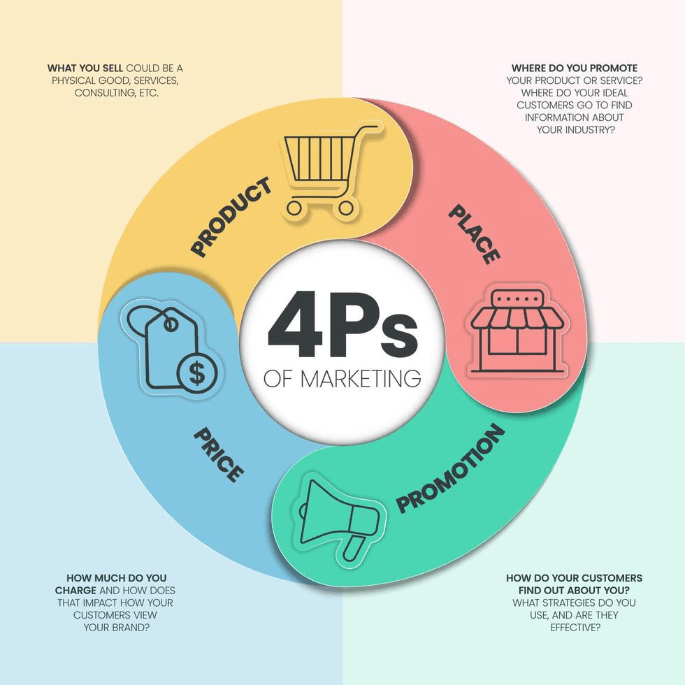
- Product: What value is being offered to the customer?
- Price: What does the customer pay, and how does pricing reflect perceived value?
- Place: How and where can customers access the offering?
- Promotion: How does the organization communicate its value to the target audience?
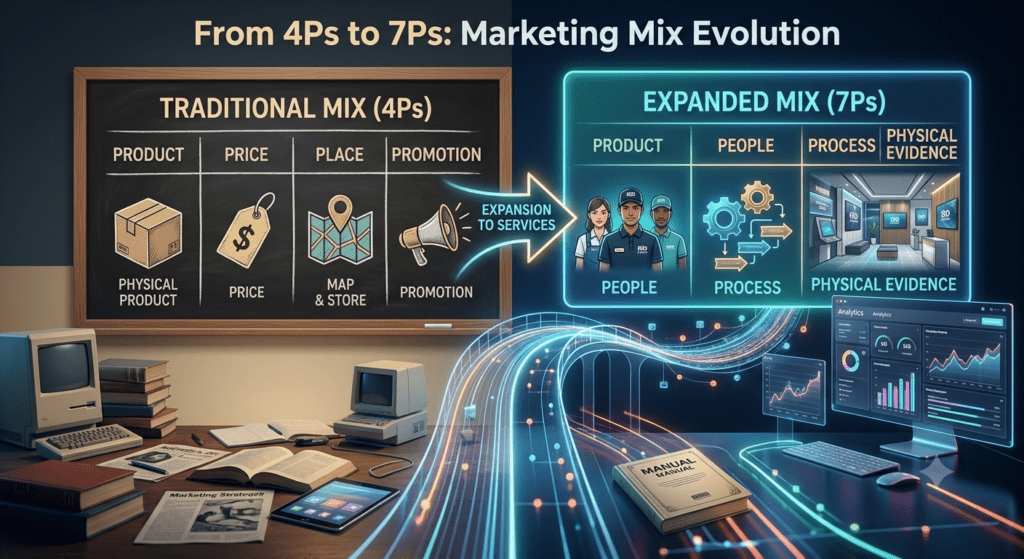
When economies began moving towards the provisioning of service offerings, the 4Ps was still a basic model with a few extra elements needed to cover the unique nature of services. The people element and the process element were added to the mix by the services-marketing framework of Booms and Bitner in 1981, along with the physical evidence element, which was added in 2000.
The three additional elements are particularly important in service marketing:
- People: Employees and other individuals involved in delivering the customer experience.
- Process: The systems and procedures through which a service is delivered.
- Physical Evidence: Tangible cues that help customers evaluate the quality and credibility of an intangible service.
Physical Evidence is especially important in service businesses because services cannot be physically examined before purchase. Customers may therefore rely on tangible signals such as branding, packaging, website design, physical environments, reviews, and professional presentation to evaluate quality and reduce perceived risk.
The 7Ps therefore extend the traditional marketing mix by recognizing that successful marketing is not only about the product being offered but also about how the customer experiences the entire delivery system.
Growth Hacking: Turning Market Asymmetries into Growth
Growth hacking is much more than simply meaning ‘marketing on a budget’ as it is a cross-functional data-driven methodology centered on discovering scalable growth opportunities through continuous experimentation and evaluation of products and services.
Growth-oriented organizations may place marketing, product development, technology, operations, customer experience, and financial functions together instead of a typical marketing function occurring in a specific marketing department.
This approach can help resource-constrained companies identify opportunities created by market asymmetries—differences in information, technology, distribution, resources, timing, or capabilities that may create an advantage.
The objective is not simply to grow quickly but to discover repeatable and scalable mechanisms that can support sustainable growth.
A central framework used in growth analysis is AARRR, also known as Pirate Metrics, commonly associated with Dave McClure.
Acquisition
Acquisition refers to how successfully a business gets new users/customers via traffic channels like social media, partnerships, referrals, content, advertisements, and search engines.
Activation
Activation occurs when users experience the core value of a product or service and take a meaningful action that indicates genuine interest or engagement.
Retention
Retention measures the ability of a product or service to keep customers engaged and encourage them to return over time.
Referral
A measure of the degree to which customers recommend or invite others to use a product or service. A growth loop is possible if part of the referral arrangement is done to help bring in new users.
Revenue
Revenue measures how effectively user activity and customer relationships translate into financial value for the organization.
The AARRR framework helps businesses move beyond measuring traffic alone and instead evaluate important stages of the growth system, from acquiring customers to creating long-term value. The exact metrics used at each stage should be adapted to the organization’s business model.
Understanding Advertising Ecosystems: Intent vs. Audience
To make prudent investments in capital, companies must begin to grasp the roles of key digital advertising ecosystems. A popular error is opting for a platform instead of significance linked to a certain advertising goal.
Two broad approaches illustrate this distinction.
Intent-Driven Advertising: Google Ads
Google Search advertising can target users’ existing demand with information they are actively seeking, products, and solutions.
For instance, people looking for ‘best accounting software for small businesses’ have a specific need in mind. This traffic can be highly effective for the tasks of capturing existing demand and high-intent traffic—and search advertising can be the effective asset with which to do these things.
But Google AdSense is not restricted to high-intent searches. Google’s advertising mix also features advert campaigns that target goals like awareness, consideration, app promotion, shopping, or conversions.
Audience-Based Advertising: Meta Ads
Businesses can target audiences with audience controls, customer data, platform signals, and automated delivery in combination with the power of Meta advertising. Advertisers can target subscribers by certain characteristics like demographics, interests, locations, custom audiences, and lookalike audiences, and optimization can be further driven by campaign goals and results by Meta’s systems.
Meta platforms can therefore be useful for building awareness, reaching potential customers, retargeting, and supporting demand generation.

The key strategic distinction is:
Search advertising can capture existing demand, while social advertising can help build awareness and create or stimulate demand.
Neither method is wholly better than the other. The right method depends on business goals or objectives, the customer’s journey, the audience, the budget, the type of product, as well as the level of demand.
The Mind of the Buyer: Understanding Consumer Behavior
Marketing effectiveness depends on understanding how consumers think and make decisions.
Customer behavior studies how individuals and groups choose, buy, use, assess, and dispose of products and services to satisfy their needs and desires.
Purchase decisions do not occur in isolation. They are influenced by multiple factors, including:
Psychological Factors
These include motivation, perception, learning, beliefs, attitudes, and personality.
Personal Factors
Age, profession, financial situation, lifestyle, phase in life, and personal circumstances are all taken into account here.
Social Factors
Family, friends, reference groups, influencers, and social networks can influence consumer preferences and purchase decisions.
Cultural Factors
Culture, subculture, values, traditions, and social norms can strongly influence how consumers perceive products and brands.
A strong understanding of these influences allows marketers to design more relevant products, messages, experiences, and customer journeys.
The Consumer Decision Process
The consumer decision-making process is commonly acknowledged to encompass the five stages of:
- Recognizing a need
- Seeking out information
- Weighing up the alternatives
- Making the decision to buy
- Evaluating the purchase afterward
Not all buying decisions go through this process in an organized way. It may be different depending on the nature of the product, the level of interest, and the amount of risk involved.
Positioning and the Consumer’s Mind
In competitive markets, being the first company to enter a market does not automatically guarantee long-term success. What matters is the position a brand establishes in the customer’s mind.
The concept of positioning emphasizes the importance of creating a distinctive and memorable association with a target audience. A brand that successfully establishes a clear position may gain an advantage through stronger recognition, differentiation, and recall.
Nevertheless, first-mover advantage should not be construed as implying certainty of success. Those who come later may succeed beyond those who have come before them thanks to technological superiority, better execution, pricing, logistics, customer experience, and so on.
SEO: The Long-Term Engine of Organic Visibility
Traffic from paid traffic can be immediate, but will likely require consistent advertising efforts to maintain the visibility. With websites consistently producing useful information and establishing a solid technical base, SEO can give long-lasting organic visibility.
However, SEO does not guarantee rankings or permanent traffic. Search results can change because of competition, algorithm updates, changing user behavior, and changes in search demand. Google itself states that there are no methods that automatically guarantee a site will rank first.
SEO can be broadly understood through three areas:
On-Page SEO
On-page SEO focuses on optimizing website content and page elements, including:
- Content quality and relevance
- Page titles
- Headings
- Internal linking
- Content structure
- Search intent alignment
- Descriptive metadata
The objective is to help search engines and users understand the relevance and value of a page.
Off-Page SEO
Off-page SEO involves activities and signals outside the website that can contribute to authority and visibility. These may include:
- High-quality backlinks
- Digital PR
- Brand mentions
- Industry recognition
- Content distribution
The objective is to establish credibility and authority rather than simply acquire links.
Technical SEO
Technical SEO focuses on the underlying technical health of a website, including:
- Crawlability
- Indexability
- Mobile usability
- Website performance
- HTTPS security
- Structured data
- Core Web Vitals
Technical SEO aids in making websites approachable to search engines while providing a positive user experience for web visitors, but it is only a part of the larger SEO strategy. Google pays attention to putting useful human-centered content in the first place in addition to technical SEO and search accessibility.
SEO should therefore be viewed as a long-term strategic investment in organic visibility, not as a one-time activity or guaranteed source of traffic.
It’s essential to look at SEO as a long-term strategy and not simply as a one-off activity or a guaranteed means of getting traffic to your site.
Data Over Guesswork: The Role of Modern Analytics
Modern marketing has increasingly shifted from intuition-based decision-making toward evidence-based decision-making.
Analytics aids companies in gathering and analyzing information on clients’ actions, campaign efficiency, web site performance, and results achieved by the business. The aim is to not only gather data but also turn it into useful information.
Google Analytics 4 (GA4) uses engagement-based measurement. An engaged session is one that continues for more than 10 seconds, includes a key event, or contains at least two page or screen views. In GA4, bounce rate refers to the proportion of sessions that did not become engaged sessions, making it the inverse of engagement rate.
However, the bounce rate should certainly not be analyzed in isolation. The high or low rate does not indicate success or failure. It is important to look at the purpose of the page, the user intent, the rates of engagement and conversions, and the business impact of the site.
Analytics becomes most valuable when connected to clear Key Performance Indicators (KPIs).
Examples include:
- Conversion Rate
- Customer Acquisition Cost (CAC)
- Customer Lifetime Value (CLV/LTV)
- Return on Investment (ROI)
- Return on Ad Spend (ROAS)
- Lead Generation
- Retention Rate
- Revenue
The fundamental principle is:
Analytics turns data into actionable information and helps marketers make decisions based on evidence rather than assumptions.
Engineering Growth: Connecting Strategy with Execution
Its development from 4Ps to growth indicators is a testament to the modern marketing landscape, which must rely upon strategic thinking and execution.
They are used to create strategic discipline because they enable the organization to be aware of and understand its offering, pricing, distribution, communication, people, process, and customer experience.
The AARRR framework provides a growth measurement structure by examining how customers are acquired, activated, retained, referred, and converted into revenue.
SEO and digital advertising provide acquisition mechanisms, while analytics provides the feedback required to evaluate and improve performance.
The strongest growth systems connect these components rather than treating them as isolated activities.
A practical growth loop can be represented as:
Set Actionable Goals → Monitor Analytics → Identify Strengths and Opportunities → Run Experiments → Optimize → Repeat
💡 Technical Skills + Marketing Skills = A Powerful Career Combination
Whether you’re a student, aspiring entrepreneur, or professional, digital marketing helps you communicate value, build audiences, and create opportunities in today’s competitive landscape.
Explore Digital Marketing Fundamentals →Conclusion
McCarthy’s 4 Ps have been replaced by Pirate Metrics, which reflects the general evolution of marketing from being a more tactical, sales-oriented function into a more integrated, data-driven, and tech-enabled growth function.
By making use of the 4Ps and the 7Ps, you should have a solid understanding of the strategy used by businesses to create and provide value. Consumer behaviour and positioning allow organizations to gain insights into consumer thinking as well as consumer competition for the audience’s attention. There are ways of reaching and acquiring customers: through SEO, paid advertising, and digital channels. Lastly, analytics, experimentation, and growth frameworks assist organizations in determining outcomes and continually enhance performance.
No single framework is sufficient on its own. The real advantage comes from combining them into a connected system.
The modern marketer therefore needs to think like both a strategist and an engineer: a strategist who understands customers, markets, positioning, and value creation, and an engineer who uses data, experimentation, technology, and systems to turn strategy into measurable growth.
Finally, growing companies are not making a decision to shift to a traditional marketing method or a modern growth method. It’s about weaving a mix of the strategic approach of the 7Ps with the measurement and experimentation philosophy of Pirate Metrics, along with solid customer insight, digital implementation, and constant optimization.
References
Books
- American Marketing Association. (n.d.). The Definition of Marketing: What Is Marketing? American Marketing Association.
- Booms, B. H., & Bitner, M. J. (1981). Marketing strategies and organization structures for service firms. In J. H. Donnelly & W. R. George (Eds.), Marketing of Services. American Marketing Association.
- Chaffey, D., & Ellis-Chadwick, F. (2022). Digital Marketing: Strategy, Implementation and Practice (8th ed.). Pearson.
- Croll, A., & Yoskovitz, B. (2013). Lean Analytics: Use Data to Build a Better Startup Faster. O’Reilly Media.
- Keller, K. L. (1993). Conceptualizing, measuring, and managing customer-based brand equity. Journal of Marketing, 57(1), 1–22.
- Keller, K. L. (2013). Strategic Brand Management: Building, Measuring, and Managing Brand Equity (4th ed.). Pearson.
- Kotler, P., Keller, K. L., & Chernev, A. (2022). Marketing Management (16th ed.). Pearson.
- McCarthy, E. J. (1960). Basic Marketing: A Managerial Approach. Richard D. Irwin.
- McClure, D. (2007). Startup Metrics for Pirates: AARRR!. Presentation introducing the AARRR growth metrics framework.
- Ries, A., & Trout, J. (2001). Positioning: The Battle for Your Mind. McGraw-Hill.
- Ries, E. (2011). The Lean Startup: How Today’s Entrepreneurs Use Continuous Innovation to Create Radically Successful Businesses. Crown Business.
- Ryan, D. (2016). Understanding Digital Marketing: Marketing Strategies for Engaging the Digital Generation (4th ed.). Kogan Page.
- Solomon, M. R. (2020). Consumer Behavior: Buying, Having, and Being (13th ed.). Pearson.
Web Reference
- Google Analytics. (n.d.). Engagement rate and bounce rate. Google Analytics Help. Google Analytics – Engagement Rate and Bounce Rate
- Google Analytics. (n.d.). Session. Google Analytics Help. Google Analytics – Sessions and Engaged Sessions
- Google Search Central. (n.d.). SEO Starter Guide: The Basics. Google. Google Search Central – SEO Starter Guide
- Google Search Central. (n.d.). Creating Helpful, Reliable, People-First Content. Google. Google Search Central – Helpful, Reliable, People-First Content
- Google Search Central. (n.d.). Google Search Essentials. Google. Google Search Central – Search Essentials
- Meta for Business. (n.d.). Ad Targeting: Options to Reach Your Audience Online. Meta. Meta for Business – Audience Ad Targeting
- Meta for Business. (n.d.). Advantage+ Audience: Ad Campaign Audience Targeting. Meta. Meta for Business – Advantage+ Audience
- OpenStax. (n.d.). The Consumer Purchasing Decision Process. In Principles of Marketing. Rice University. OpenStax – The Consumer Purchasing Decision Process
🚀 Ready to Build Real Cybersecurity Skills?
Go beyond theory with hands-on lessons in network security, ethical hacking, Linux, web security, and system hardening.
Explore the Course →