

Introduction
An economic cyclone hit India in 1991. The country’s currency reserves were barely enough to cover three weeks of imports. The country found itself at a crossroads due to fiscal mismanagement; what followed was not just a crisis response but a defining moment. The dire situation gave rise to much-needed economic reforms, which meant opening up India to the world—to break away from protectionist policies that lasted for decades, and to embrace a new mode of liberalization, privatization, and globalization. The story that followed was of booming GDP, a galloping middle class, and finally an India that was “open for business.”
But behind the headlines of economic resurgence lies another story—the more interesting story of employment possibilities.
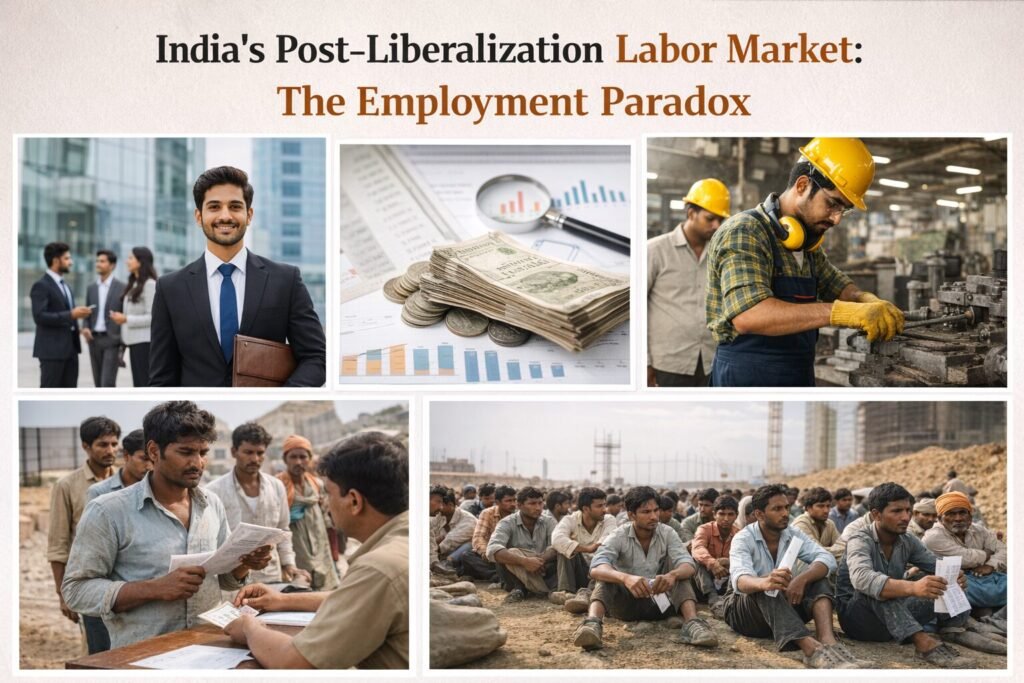
Did globalization really create jobs for all, or did it pose a significant inequality threat and informalize the labor market? Did the hundreds of thousands of young Indians entering the labor market find decent opportunities, or were they trapped in a paradox—that the fastest-growing economy is offering fewer jobs?
This study examines these issues, analyzing the state of India’s post-liberalization labor market.

Liberalization and Its Promises
The 1991 economic reforms aimed at dismantling the License Raj, lowering import tariffs, promoting exports, and encouraging FDI. Liberalization was expected to:
- Provide employment through increased competitiveness
- Foster entrepreneurship and innovation
- Attract global capital and technologies
- Move labor towards more productive and export-oriented industries
These structural changes were expected to reap great benefits for India, a labor-abundant economy, by enabling better integration with global supply chains.
Empirical Trends in Employment Post-Liberalization
Jadhav and Arora emphasize that between 1989–90 and 2005–06, output value in manufacturing grew at an average rate of 7.4% per annum, whereas employment grew by only 0.9%. Various sub-periods showed employment elasticity—how responsive employment is to output growth—remaining alarmingly low or even negative.
Several reasons have been attributed to explaining why employment has become detached from outputs:
- Automation and capital-intensive technologies
- Structural changes favoring high-skill sectors
- Casualization of labor
Contract vs. Regular Employment
The new economy gave rise to contract work. Facing new competitive pressures, firms shifted away from permanent jobs toward short-term contracts to achieve labor flexibility. The fixed-effects panel analysis, reported in Jadhav & Arora (2023), suggests that the number of contract workers has increased at a much faster rate than the number of regular workers, particularly in those industries with higher inflows of foreign direct investment. While this trend has led to decreasing labor costs for firms, the casualization of labor made employment more insecure and denied workers access to basic benefits.
Sectoral and Gendered Impacts
Export-Oriented vs. Import-Competing Industries
Jadhav and Arora classify industries as Export-Oriented (EO), Import-Competing (IC), Export-Oriented/Import-Competing (EOIC), and Low Trade Dependent (LTD). Their analysis shows:
- EO industries had high growth in output but generated low employment.
- IC industries registered better employment growth of 3.8% per annum.
- LTD industries were least responsive in employment generation.
The inference is that export expansion, being capital- or skill-intensive, would not create mass employment opportunities for low-skill workers.
Women and Skill-Based Employment
One of the most telling findings was the disproportionate impact on women and unskilled workers. Liberalization led to some increases in female participation; however, the broader trend was not gender equitable. Women’s employment remained largely in low-wage, informal sectors. Furthermore, import competition reduced employment for both men and women but particularly hurt unskilled labor—perhaps because firms find automation or outsourcing to be cheaper ways of controlling costs.
The Role of FDI and Technology
Foreign Direct Investment (FDI) played a dual role:
(1) Providing positive employment effects in capital-intensive and high-productivity sectors.
(2) Creating greater demand for skilled rather than unskilled workers.
Foreign firms brought advanced technology and demanded skilled and educated workers, thereby increasing the skill premium. Domestic firms needed to respond to intensifying global competition or exit the market. Consequently, job security became volatile, especially for MSMEs.
Challenges in Unorganized Manufacturing
Since the unorganized sector employs most of India’s workers, output grew slowly (3.4%) while employment almost stagnated (0.6%) from 1989 to 2006. The sector never benefited from productivity gains under liberalization and remained starved of finance, technology, and access to export markets.
Moreover, it has become a structural characteristic of India’s labor market that informal work increasingly lacks social security or legal protections. The sector did not benefit from liberalization.
Policy Lessons and the Way Forward
Recognition of Diversity in Trade Outcomes
The empirics suggest that trade liberalization acts differently across sectors and demographics on employment. EO sectors fared very well in value addition but lacked strong capacity for job creation. IC sectors provided greater employment scope, probably because they were less capital-intensive. Hence, blanket liberalization without sectoral policies may not be effective.
Strengthening Skill Development
The skill-biased nature of employment growth after liberalization has necessitated immediate upskilling and reskilling of the Indian workforce. Government schemes like Skill India should be better aligned with industry needs, particularly in export-oriented and high-tech sectors.
Ensuring Protection for Vulnerable Workers
Contract-type jobs and informalization will increase. This calls for stronger legal protections for workers. Greater attention must be paid to their social security, minimum wages, and job safety nets to protect workers competing in a global economy.
Fostering MSMEs
Given their employment-intensive nature, MSMEs require focused support in finance, market access, and infrastructure. This would help fairly distribute the benefits of globalization.
Conclusion
Trade liberalization has elevated the Indian economy to the global platform. However, the promise of mass employment gains remains only partially fulfilled. As this study demonstrates, trade liberalization is not a remedy; it presents both opportunities and risks. Therefore, an evidence-based policy approach focused on skills, equity, and sectoral diversity is crucial to ensure the next phase of India’s economic development is truly inclusive for its job market.
References
- Panagariya, A. (2008). India: The Emerging Giant. Oxford University Press.
- Jadhav, V., & Arora, P. (2023). Liberalization and Employment in Indian Manufacturing: A Sectoral Analysis. Indian Journal of Labour Economics, 66(1), 101–120.
- Government of India. (1991). Economic Survey 1990–91. Ministry of Finance.
- Kannan, K. P., & Raveendran, G. (2009). Growth sans Employment: A Quarter Century of Jobless Growth in India’s Organized Manufacturing. Economic and Political Weekly, 44(10), 80–91.
- Ghose, A. K. (2016). India Employment Report 2016: Challenges and the Imperative of Manufacturing-Led Growth. Institute for Human Development & ILO.