

ISRO launch vehicles have evolved India’s space technology from SLV-3 in 1980 to powerful LVM3 for Chandrayaan-3. These rockets – PSLV, GSLV, LVM3 – enable satellites, navigation like NavIC, and human missions like Gaganyaan. Under Indian Space Policy 2023, they solve real Earth problems through communication and climate monitoring.
Such operations offer new means to address global challenges. It plays a crucial role in the modern world by enabling communication, navigation systems, weather forecasting, and climate monitoring through advanced space-based mechanisms.
Indian Space Policy 2023: It aims to boost India’s space capabilities and enable commercial space presence. It also focuses on using space to drive technology development, pursue international collaboration and create an ecosystem for implementing space applications.
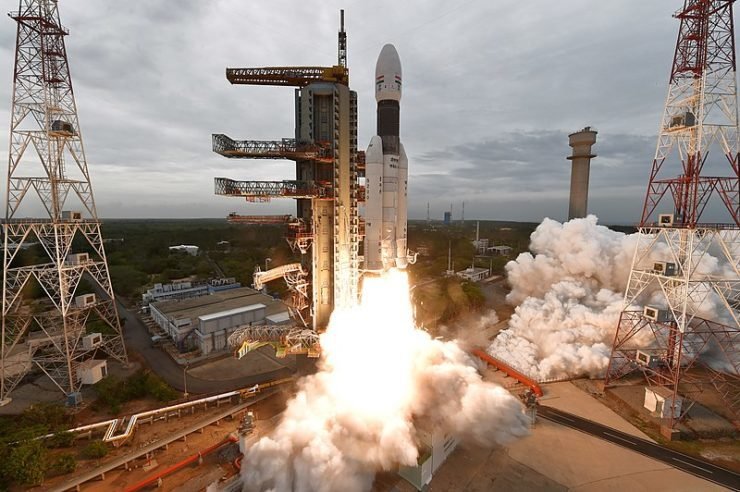
Launch Vehicles
A launch vehicle is a rocket-powered vehicle which is used to transport a spacecraft beyond Earth’s atmosphere. It transports either into orbit around Earth or to another destination in outer space.
Working of ISRO Launch Vehicles-
Launch vehicles are rockets that rely on basic principles of action and reaction, described by Newton’s third law of motion. They have multiple stages that detach and fall away as the rocket moves forward. Each stage has its own engines and propellant. These are discarded when no longer needed.
The vehicles use a combination of fuel and oxidiser, called propellant, to generate thrust. They have a guidance system to maintain their intended trajectory. The payload, such as a satellite, is enclosed with a protective shell called a payload fairing. Once the rocket reaches space, the fairing is jettisoned to expose the payload and the satellite is inserted into the intended orbit.
India’s launch vehicles
SLV-3: Satellite Launch Vehicle
It is India’s first experimental satellite launch vehicle, launched on July 18, 1980.
It was a four-stage vehicle that launched from Sriharikota, and the Rohini satellite(RS-I) was placed in orbit. Its payload capacity was 40kg.
ASLV: Augmented Satellite Launch Vehicle
It was a five-stage vehicle, with the mission of orbiting 150 kg class satellites into 400 kms circular orbits.
Both SLV and ASLV are retired now.
PSLV: Polar Satellite Launch Vehicle
It is India’s third-generation launch vehicle, first successfully launched in October 1994. It is a four-stage vehicle and regarded as the workhorse of ISRO for the Lower Earth Orbit. It can carry upto 1750 kg to 600 kIt successfully launched Chandrayan-1 in 2008 and Mars Orbiter Spacecraft in 2013.
GSLV: Geosynchronous Satellite Launch Vehicle
It is a fourth-generation launch vehicle designed to place communication satellites in geostationary transfer orbit using a cryogenic third stage. It was used for launching Chandrayaan-2. GSLV is capable of placing up to 6 tonnes of payloads in Low Earth Orbits, from heavy satellites to multiple smaller satellites.
LVM3: Geosynchronous Satellite Launch Vehicle MKIII
It is a next-generation launch vehicle. It is a three-stage vehicle with two solid strap-on motors and one liquid core stage. It is capable of putting the GSAT series’ 4-tonne satellite into a geosynchronous transfer orbit. Recently, it was used for launching the Chandrayaan-3 mission.
ISRO’s Major Space Missions
Since its inception in the 1960s, India’s space program has made significant strides, marked by ambitious missions to the Moon and Mars. It showcases India’s advanced capabilities in launch vehicles and satellite technology, primarily focusing on how these advancements can benefit society.
ISRO’s Missions-
- NavIC: India’s independent satellite navigation system
- Gaganyaan Mission: India’s first human spaceflight program
- Chandrayaan Missions
- Mangalyaan (Mars orbiter mission)
- Aditya L-1: India’s first solar mission to study the Sun.
- NISAR: A joint NASA and ISRO mission
- LUPEX: A joint lunar mission with Japan.
- Shukrayaan-1: An orbiter mission to Venus.
- Mangalyaan-2: A follow-up mission to Mars.
- Chandrayaan-4
References
- Official overview of India’s launch vehicles including PSLV, GSLV, and LVM3. ISRO Launchers Page (isro.gov.in in Bing)
- ISRO – PSLV (Polar Satellite Launch Vehicle). Technical details, history, and missions of PSLV.
- ISRO – GSLV (Geosynchronous Satellite Launch Vehicle). Specifications and mission highlights of GSLV.
- ISRO – LVM3 (GSLV Mk III). Next-generation launch vehicle used for Chandrayaan-3 and GSAT series. ISRO LVM3 Page