


Don’t start your programming journey without knowing about trends. C Programming is one of the first programming languages, and it has become a top language in the modern era. Even with the emergence of new languages such as Python, Rust, and Go, C is becoming a popular language in many areas. Here are the reasons why C is still in trend. Did you know that C is called the mother of all languages?
Did you know? The Linux kernel, which powers millions of devices, is written in C!
“C is not just a language; it’s a way of thinking about efficient computing.” – Dennis Ritchie.
1. The Foundation of Modern Programming
Many modern languages like C++, Java, and Python are significantly influenced by C. While other contemporary languages also borrowed syntax and features from C, making C an essential foundation for programmers to understand how the embedded system works at a fundamental level.
#include <stdio.h>
int main() {
printf(“Hello, World!\n”);
return 0;
}
What can you learn after understanding C?
- How the memory actually works
- How the hardware and programs interact with each other.
- What happens behind high-level abstractions
Learning C is important, but learning it the right way is equally crucial. Read our article, Top 10 Mistakes Students Make While Learning C Programming, to discover common pitfalls that prevent students from mastering the language.
2. Performance That Still Beats Most Languages
C is commonly known for its speed and efficiency, making it a top priority for every tech professional. Unlike other interpreters’ languages, C is compiled directly into machine code, which results in faster execution in real time. These parameters make the C ideal for system programming and game development
- Compiles directly into machine code
- Has minimal runtime overhead
- Gives precise control over resources
3. Operating Systems and Embedded Systems
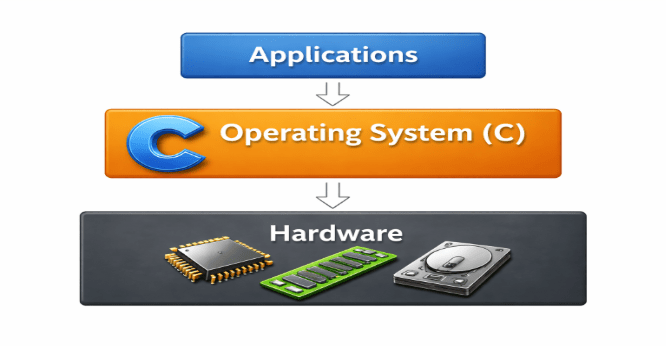
If we talk about core components of Linux, Windows, and macOS, they are written in C. C is a preferred language for embedded systems, microcontrollers, and IoT devices using minimal resources and direct hardware interaction.
4. Portability and Cross-Platform Development
A C program can be compiled and executed on different platforms without modification, providing portability. It’s especially useful for developing cross-platform applications and embedded software.
5. Embedded Systems and IoT Growth
Increasing demand for IoT devices and embedded systems helps C to continue thriving. C is used to develop firmware and low-level software required for sensors, robotics, automotive systems, and smart devices.
6. Security and Low-Level Programming
It gives programmers direct control over memory and system resources, which is crucial when developing secure, robust applications. Cybersecurity professionals also use C to analyze vulnerabilities and write efficient security tools.
7. Game Development and Graphics
Using C as a core, many gaming engines and graphic libraries industries such as Unreal Engine and Open GL is still used, giving performance benefits and a preferred choice for developing high-precision gaming applications.
8. High Demand in Industry
The use of C programming within the automotive, aerospace, telecommunications, and networking industries provides many different companies with C experience for their respective firmware development, kernel programming, and high-performance computing projects.
| Industry Area | Usage Percentage |
| Embedded Systems | 40% |
| OS / Kernel | 25% |
| Telecommunications | 15% |
| Others | 20% |
9. Active Community and Continuous Improvement
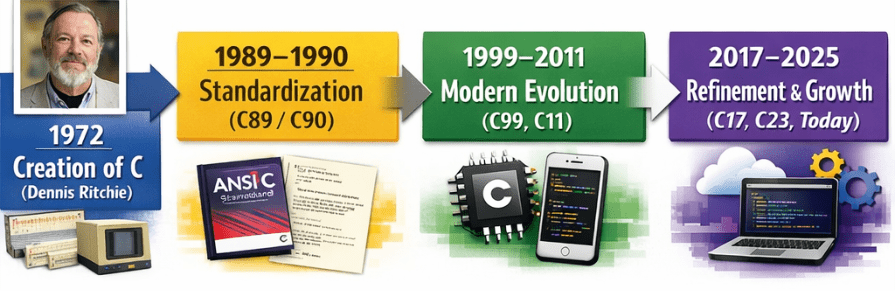
C has a large, active, and continually growing community of contributors to its libraries and tools. As an older language, many of the standards (C11, C17, and C23) for C are still evolving, thus allowing for a good long-term commitment to the project.
10. Learning C Helps in Understanding Other Languages
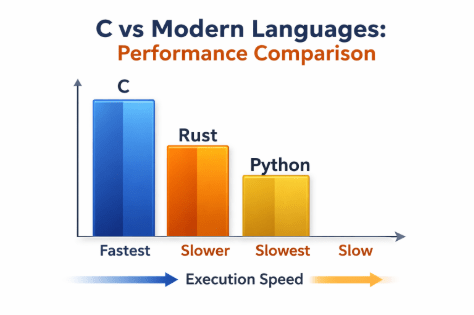
Because of the many modern languages that have been created based on ideas from the C language, when developers learn to use C, they’re getting an insight into how programming works, as well as how to manage memory and operate with system architecture alike. By learning C, developers will find it easier to learn other languages, such as C++, Rust, and Go.
| Feature | C | Python | Rust |
| Performance | Very High | Medium | High |
| Memory Control | Manual | Automatic | Safe/Controlled |
| Ease of Use | Moderate | Easy | Moderate |
| Use Case | Systems/Embedded | Web/AI | Systems |
Conclusion
C is expected to remain an important language for both new programmers as they learn about programming and experienced developers building systems from scratch in 2026 – and beyond – because of its performance, efficiency, portability, and extensive use in major commercial applications.
References
- Dennis Ritchie & Brian Kernighan
The C Programming Language (2nd Edition), Prentice Hall, 1988
👉 https://www.amazon.com/dp/0131103628
- Stephen G. Kochan
Programming in C (4th Edition)
👉 https://www.amazon.com/dp/0321776410
- Herbert Schildt
C: The Complete Reference
👉 https://www.amazon.com/dp/0072121246
- GeeksforGeeks
👉 https://www.geeksforgeeks.org/c-programming-language/
- W3Schools
👉 https://www.w3schools.com/c/
- TutorialsPoint
👉 https://www.tutorialspoint.com/cprogramming/index.htm